A story · the piggy bank
Where did my money go?
A piggy bank is a great start, but it only answers one question.
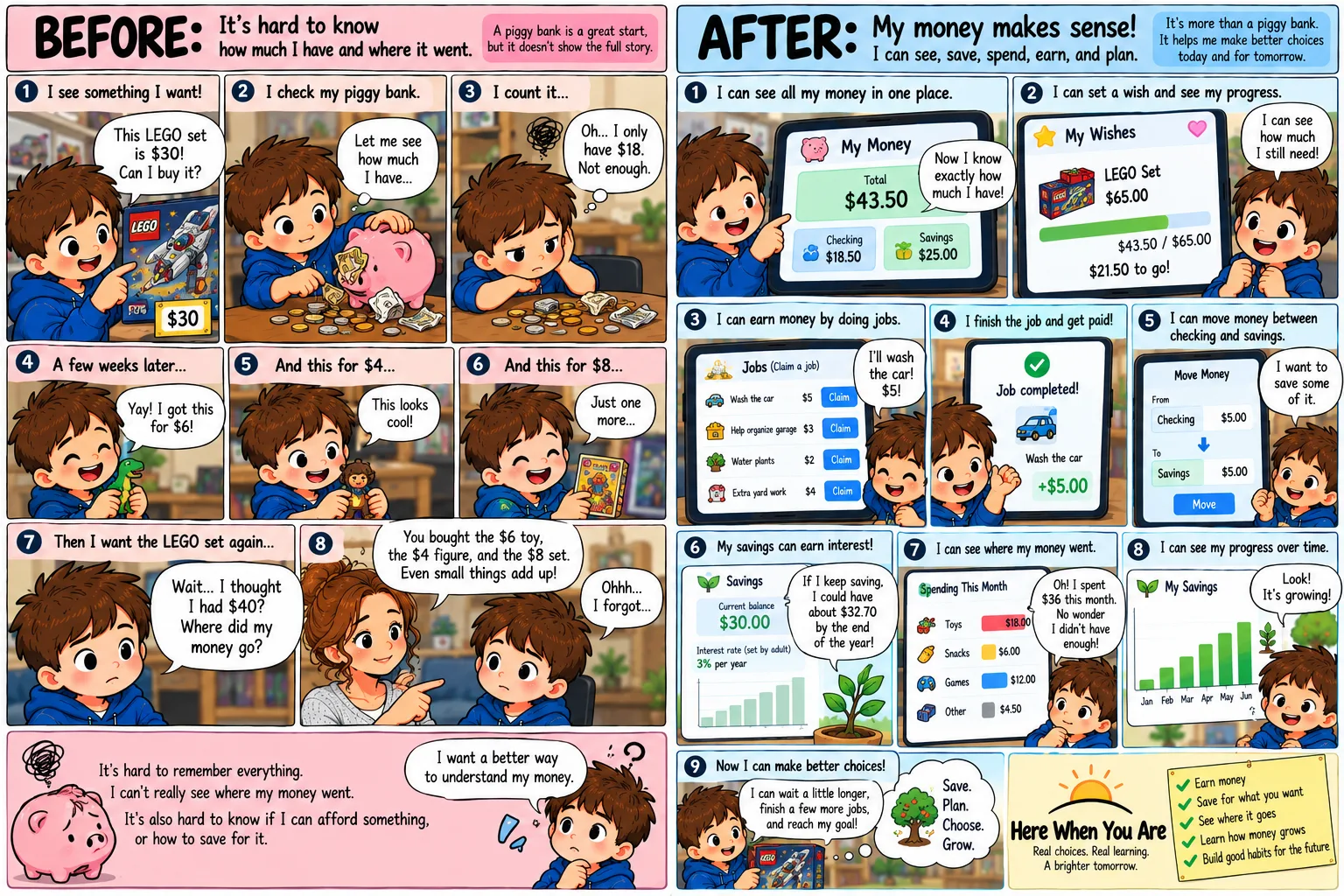
Before
It's hard to know how much I have — and where it went.
1“This LEGO set is $30! Can I buy it?”
A real want, pointed at from the shop floor. The question underneath it — can I afford this? — is one he has no way to answer.
2“Let me see how much I have…”
The pig comes off the shelf and goes upside down. This is the only way a piggy bank can be asked anything.
3“Oh… I only have $18. Not enough.”
Counting coins at the table. It tells him where he stands today and nothing about how he got here.
4A few weeks later…
“Yay! I got this for $6!” A small thing, bought on the spot. Nothing about it feels like a decision.
5“This looks cool…” — $4.
And then “just one more…” for $8. Each one is fine on its own, which is exactly the problem.
6“Wait… I thought I had $40? Where did my money go?”
Mom can list it back to him — the $6 toy, the $4 figure, the $8 set. “Ohhh… I forgot.” He isn't careless. He simply had nowhere to look.
After
My money makes sense. I can see, save, spend, earn and plan.
1All my money in one place.
Total $43.50, split into checking and savings. “Now I know exactly how much I have!” — without tipping anything out.
2A wish, with the distance on it.
LEGO Set, $65.00. A bar filling up: $43.50 of $65.00, $21.50 to go. Not “no” — a number he can do something about.
3Jobs he can claim.
Wash the car $5, help organise the garage $3, water the plants $2, extra yard work $4. Real work, priced before he starts, taken because he chose it.
4Finish it and get paid.
Job completed — wash the car, +$5.00. The money lands the moment the work does, in the same place the total lives.
5Moving money between checking and savings.
“I want to save some of it.” $5.00 from checking to savings. Saving becomes a thing you *do*, not a thing you are told about.
6Savings that grow on their own.
3% a year, set by a grown-up. “If I keep saving, I could have about $32.70 by the end of the year!” Interest stops being a word and becomes a picture.
7Where the money went.
Spending this month: toys $18, snacks $6, games $12, other $4.50. “Oh! I spent $36 this month. No wonder I didn't have enough!”
8Progress over time.
Six months of savings, going up. “Look! It's growing!” The thing a pig full of coins can never show.
9Better choices, made by him.
“I can wait a little longer, finish a few more jobs, and reach my goal!” Save. Plan. Choose. Grow.
Real choices. Real learning.
The piggy bank in Here When You Are holds real dollars, never points — the two are kept apart on purpose, because a currency you can only spend inside an app teaches nothing about the one outside it. A grown-up sets the interest rate and decides whether money can come out as cash. Everything else belongs to the child: what to take on, what to save for, and what a month of small things actually cost.
how much.
Not where it went.